Under the Canopy: Caregiving through the Seasons: The Repair
Written by our therapist, Miranda, MSW, RSW
The Repair
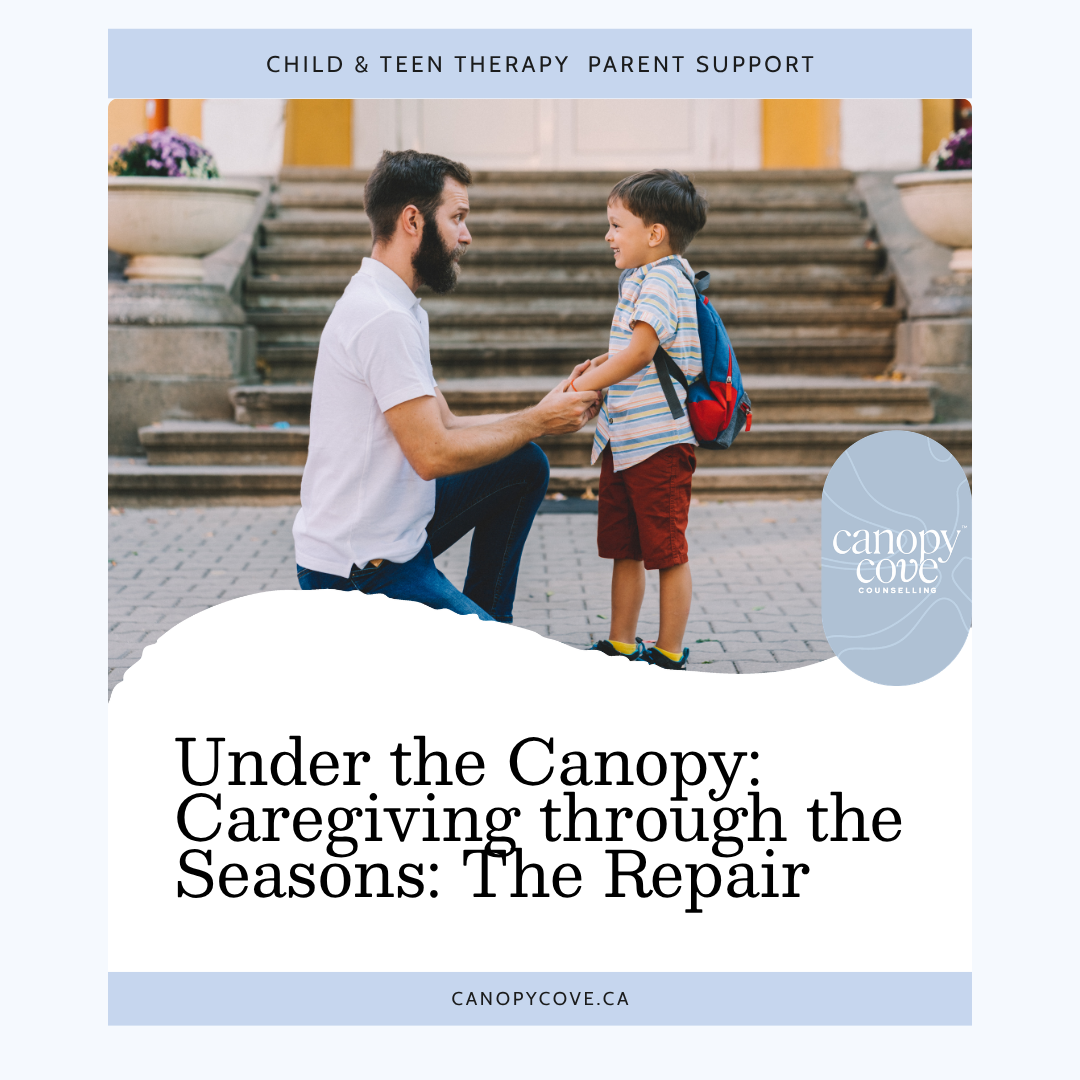
Have you ever had a moment with your child or teen where you reacted in a way you are not proud of? Maybe you misread a cue your child was giving you, lost your patience, maybe you shut down, yelled, said something you didn’t mean or reacted in a way that made you and your child feel awful. Every caregiver has moments where they react in ways they wish they had not and would give anything to take these moments back. I am here to tell you that every rupture has the ability to repair and the moments when an adult can come to the child and say, I am sorry, can teach our children that conflict can exist without disconnection. This week we are exploring how we can strengthen our bonds with our children after conflict through repair.
Parenting and Our Own Childhood
Parenting has a way of exposing our own childhood and the patterns, and unresolved emotions and needs we may still have unmet. Our children have an amazing ability to trigger parts of ourselves that we may not have paid any attention to in the past. This could look like reacting to your child who is whining non-stop, this could be especially triggering to a parent who was constantly yelled at for whining. Our nervous system responds to our children and we can be more reactive to the things they do that we may have been disciplined for as children ourselves. Working on recognizing the behaviours our children engage in and how we are responding internally to this can help us better plan for how we can parent moving forward. We can also struggle to be our best selves especially when we are outside our window of tolerance and when we are overwhelmed we tend to have less patience and can snap at those we love, including our children. When we experience a rupture with our child or teen it can leave them feeling unseen, misunderstood and at times, unsafe. Our role as the caregiver is to teach our children that conflict can happen but love and trust is not easily broken and we can reconnect.
Building Secure Attachment Through Rupture and Repair
Supporting a healthy secure attachment with our children is not easily broken. Safety in a relationship comes from many ruptures and repairs and when we are always coming back to our child when we don’t quite get it right the first time we are building safe and secure attachments. An example of this is when we come home with our new baby and they won’t stop crying. We try changing them, feeding them, walking them, patting them, burping them, washing them and we don’t give up. We may not get it right the first, second or third time, but safety is built by not giving up and trying again and again.These small moments over time create a secure and healthy attachment. Parenting is not about perfection, it is about not giving up.

So, There Has Been a Rupture, Now What?
So, there has been a rupture, now what? Repair is about taking ownership and accountability of your behaviours and acknowledging its impact on your child. When we do this we teach our children that their feelings matter, that you care about the relationship and that after a conflict or missed cue, there is always an opportunity to come back and try again. When repairing with my own children I use the acronym R.E.P.A.I.R.R
R: Regulate Yourself.
Take a few moments to breathe, put some cold water on your face, step outside and remind yourself that parenting is not about perfection. When you feel calm, come to your child with a soft face and tone. When you are calm, it supports your child and teen being calm as well.
E: Establish Safety:
Help your child to feel calm and regulated. You can do this by coming in, being regulated yourself, rocking, having them push a wall, reading to young children, sitting below or lower than your teen or child, and by letting them know that you are there to apologize.
P: Put a Name to it / Paint the Picture:
Describe exactly what happened while taking ownership. An example could be “I started feeling very overwhelmed and I yelled at you,” or “When I saw the muddy shoes on the carpet I felt angry and I yelled and said ____.” By naming your emotion and describing what happened, you are teaching your children emotional literacy and affirming to them what happened.
A: Apologize Directly:
This is where you take responsibility and apologize for your reaction. There are three steps to a good apology:
The apology: “I am sorry”
What you are apologizing for: “I yelled and that was not how people who love each other talk to one another”
Next steps:“I will work harder at calming down when I get angry so I can focus on teaching rather than making you feel bad or scared”
I: Identify their Feelings:
This is where we support understanding, emotional literacy and we validate their experience. This can look like “I can imagine you must have felt scared when I yelled” or “When you came to me about the challenge you were facing at school and I was on my phone and was not listening, I can imagine you may have felt like I did not care which may have been hurtful.” When we feel seen and understood, it supports the relationship and can increase safety within a relationship.
R: Relationship:
If your child is ready, support the relationship by hugging, doing something together, and giving them an opportunity to share. Asking them if they have anything they want to share can allow them the opportunity to have their voice heard. Asking if they would like to hug it out or if they want to do something together can help reconnect after a rupture. The relationship between a child, teen and parent is the most important thing.
R: Reinforce the Boundary:
This can look like making a plan for the child and parent for when something similar happens again. If this was about muddy shoes on the floor: “Next time, can you put your muddy shoes outside and I will take five minutes to calm down when I feel overwhelmed by a mess.” “In the future, can we have a code word when I am feeling overwhelmed about whining and I will go and take a few minutes before we figure out what you need?” Our role as parents is to teach our children and by using REPAIRR after rupture and coming back to the problem and collaboratively problem solving with them, we are teaching them invaluable skills about relationships, communication, accountability, conflict, problem solving and we are supporting attachment above all else. Remember, parenting is not about being perfect!
Support for Parents and Families
If you are finding that you are often feeling overwhelmed in parenthood and the ruptures are becoming frequent, we are all here at Canopy Cove to support you. Parenthood is not easy and our children can trigger parts of ourself from our own childhood that are not yet healed. Our skilled therapists are here to support parents, teens, children and the whole family. Fill out our intake form to be matched with a therapist or book a free consultation directly on our site. If you have any questions our office manager is responsive to texts or email at hello@canopycove.ca.
Resources on Repair & Supporting the Parent Child Relationship
Dr. Daniel Siegel : Parenting from the Inside Out
Dr. Becky Kennedy: Good Inside