Under the Canopy: Caregiving Through the Seasons: Finding your Calm in the Chaos

Written by our therapist, Miranda, MSW, RSW
Welcome to a new caregiving series where we offer parents and caregivers support and guidance through the toughest seasons of raising children and teens. We hope to extend our community of caregivers a village of support because no one should have to raise children alone.
This series will offer tools, strategies and a variety of resources that can offer caregivers a branch of support. We are so excited you are here and if there are topics you wish us to cover, please reach out and we will be happy to explore it in this new series.
This week's blog is all about Finding your Calm in the Chaos.
When Caregiving Feels Like Too Much
Picture this: you are cooking and the fan is on, the toddler is crying to be picked up, your school-aged child is shouting while playing with their trucks, your teen is blasting their music, the dog is barking, and then your partner walks in and asks where something is…
I am not sure about you, but even thinking of this has my heart racing.
These moments in caregiving, where our brain is pulled in so many directions, can ignite our nervous system to dangerous levels. When we are stressed or overwhelmed, we may not always show up as our best selves.
We may find ourselves yelling at our partner or shouting at the dog, we may storm off or completely shut down and ignore everyone, we may even do or say something to our children that we don’t mean.
Sometimes it feels impossible when the chaos of caregiving is beyond our window of tolerance and we need new tools and strategies to support ourselves so that we can be our best.
Let’s explore what our window of tolerance is, ways we can recognize when our nervous system needs support, and some strategies to help us stay calm during the chaos.
What exactly is a “Window of Tolerance?”
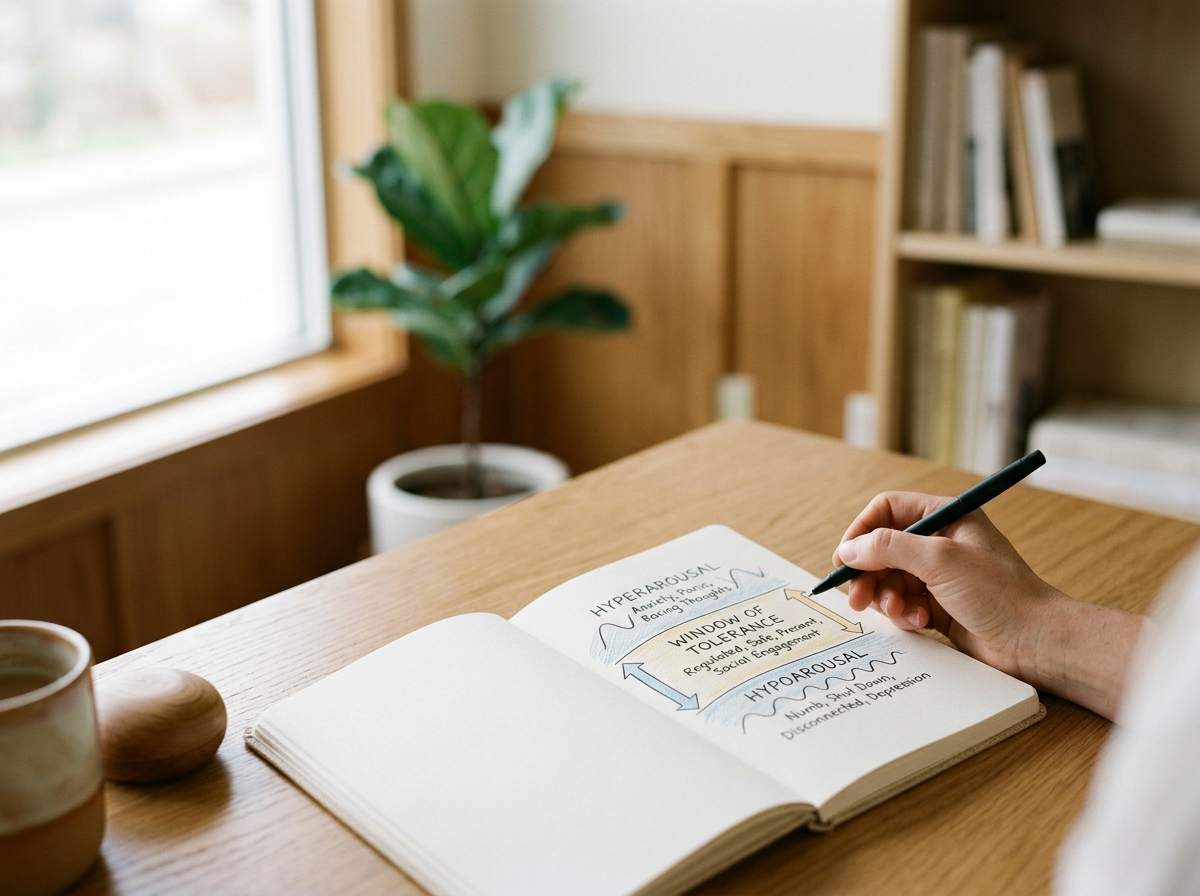
When I first learned about the Window of Tolerance, I felt so validated and could better understand why I was wanting to run away during stressful moments, why I was doom scrolling after the kids went to bed, or why I was picking fights with my husband when the mental load was too much; yes, therapists have moments too!
Our nervous system was designed to keep us alive which means it reacts to our environment all the time and when things are perceived as a threat, we respond in different ways.
When we are faced with threats we can respond in a few ways; we can fight, flight or freeze.
Understanding fight, flight or freeze in Parenting
In parenting this can look like us yelling, throwing things, slamming doors, maybe we run away and shut our doors, maybe we scroll on our phones for hours or lay in our bed and feel like we can’t move.
When we are reacting this way, it can give us a clue that we are outside our window of tolerance and are immobilized or hyperaroused (shut down/ dissociative) or we are mobilized or hyperaroused (fighting or flighting).
Our body gives us clues that we are entering these stages and by getting familiar with how our body responds we can help ourselves during the chaotic moments.
Think of the scenario above where the house is loud and our mind is pulled in a million directions; is your heart racing, are you sweating, can you think, does your skin feel like it is crawling?
Getting to know your body can be a great way to know it is time to use a coping skill.
What Does It Feel Like To Be In Your Window of Tolerance?
When we are our best, we are social, engaged, and we can communicate and problem solve. This part of our window is our social engagement and this is our goal. We can experience challenging moments and parenting can be stressful but we can manage it and cope.
Being in our ideal range does not mean that things are easy peasy, it just means that we can handle stress without flipping our lid.
The more we practice our coping skills and find out what works best for us, the larger our window of tolerance gets and we can find ourselves coping better during the chaos a little better.
10 Tools to Cope Through the Chaos
Now that you know what is happening with your window of tolerance, here are 10 tools that you can try to help stay calm during the chaos:
Get really good at reading your body and knowing your stress triggers.
You can create a list of triggers that move your body into fight, flight or freeze. Then, next to the triggers, write down what your body does and what you tend to do. For example, your partner stuffs their socks in the couch; your heart race increases, you scrunch up your face then you yell at your partner. Once you recognize the sensations and what is happening around you, you can better plan for how you can use your coping skills to stay within your window of tolerance.
If you have a caregiving partner, come up with a word that you can say when you need a quick break.
For example, if I say “dinosaur”, that means my partner jumps in and takes over, no questions asked. This can give me time to take a breath and collect myself by walking away from a chaotic situation.
Humming.
When your nervous system is triggered, and you can’t step away, try to hum a song that you enjoy.
Move your body.
This can be by jumping, shaking your arms, swaying back and forth or even dancing. Movement allows stress to move and can be a quick way to cope and regulate your nervous system.
Cold water.
You can splash cold water on your face, put a cold cloth on your neck, or you can drink cold water from a straw. Cold water is like a shock to your system and can quickly get your thinking brain back online.
Meet your needs.
Ask yourself, when is the last time you ate, drank water, or moved. Have a quick snack or drink a glass of water (it can be more regulating with a straw), and see if that helps.
Get playful.
When we play, we are in our social window and can activate the feel good chemicals in our brain. If you need to yell, act like a monster or a dinosaur, if you need to move, play chase with your kids, if you need to stomp, challenge your kids who can stomp the longest. Play can get everyone on the same wave length and can quickly turn stress into fun.
Get outside.
If you have a moment, step outside, put your feet on the ground and notice nature. If you can go for a walk, double points!
5-4-3-2-1
Get grounded. Notice 5 things you see, 4 things you can touch and feel, three things you hear, two things you smell, and one thing you can taste. Getting back into your environment can be a great way to calm your nervous system to remind itself that you are not in danger.
Make a calm kit.
Have earplugs (Loop earplugs are amazing and can limit sounds without shutting them all out), have a calming essential oil, or soothing lotion you enjoy. Sour candy is a great way to reactivate a hypomobilized system. Gather the things you enjoy and have them close by so that you can quickly use them when things feel chaotic.

Your Calm Can Help Your Children Find Theirs
These ten strategies are just a small list of coping tools that you can use when you are noticing things are feeling chaotic.
The cool thing about practicing these tools, is that the kids are watching and they will use the tools you use to help their systems stay calm.
Getting to know your stress triggers, understanding your window of tolerance and how your body is reacting during stress and then finding the right tools to help stay within your window, can all help create more calm during chaos.
You Don’t Have To Navigate Caregiving Alone
If you are finding that parenting or stress is becoming unmanageable and that you want to learn more and build more tools, reach out to the clinic and book a consultation call with one of our incredible therapists.